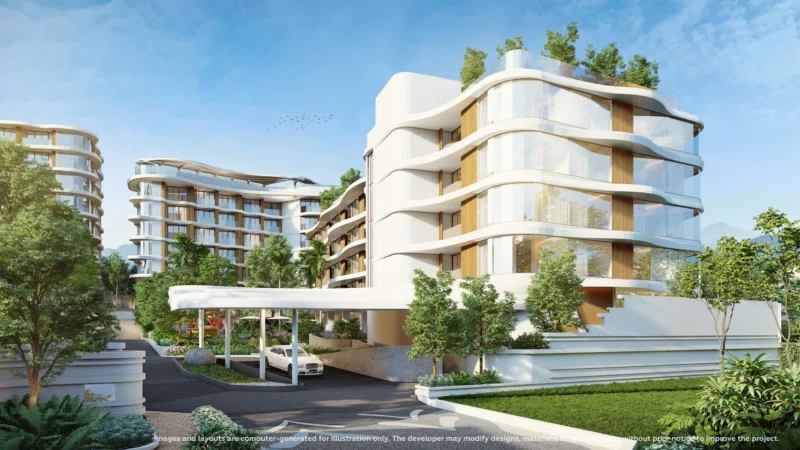
Object typeResidential
Completion dateQ4 2028
DeveloperESM Company Group
Total areafrom 35 m² to 72 m²
Down Payment5 962 $

Sometimes a buyer says: “I like Rawai. I’d live there myself.” But they’re not looking for a place to move into — they’re looking for a property purely to rent out to tourists.
At this point, it’s easy to make one of the most common mistakes in the resort real estate market: choosing an investment property based on your own personal taste.
An area that’s convenient for you to live in permanently isn’t necessarily the best fit for someone who’s coming to Phuket for just one or two weeks. Conversely, a strong tourist location doesn’t have to be the ideal place for a family, school, office, and everyday commutes.
That’s why, when analyzing VIBE Residence Karon, the right first question isn’t:
“Would I like to live here myself?”
But rather:
“Who will be renting this apartment, why would they choose Karon, and what should convince them to book this particular unit?”
This isn’t a debate about which area of Phuket is better. It’s a discussion about whether the property matches the purpose of the purchase.
VIBE Residence Karon is a development by ESM Development under construction in the Karon area. According to the developer’s official resources, the project includes 309 units; studios and apartments with one or two bedrooms are available to buyers. Studio areas start from 28 m². As of September 11, 2026, the project website indicates that construction has begun.
Official materials position the complex as a resort product located near Karon Beach and Karon Public Park. In the developer’s presentation, the distance to the beach is stated as 0.1 km, but for a buyer, this figure is only the starting point for verification. It doesn’t reflect the actual length and quality of the walking route, the terrain, lighting, crossings, or how convenient the path is with a child or luggage.
That’s exactly why it makes sense to analyze VIBE Residence Karon not just as a set of building specifications, but as a future accommodation product.
For someone coming to Phuket on vacation, the area is often chosen based on a simple set of scenarios:
Karon fits precisely this resort-oriented scenario. Guests usually choose it not because they plan to build a long‑term life here, but because they want a straightforward holiday experience close to the sea and services.
This is what creates the investment logic of the project: the potential user of the apartment isn’t an abstract “tenant,” but a tourist with specific expectations.
However, a strong location alone doesn’t guarantee occupancy or profitability. It only provides a premise for demand. The financial outcome depends on the unit itself, the quality of the project, the launch date, competition, rental rates, management, costs, and the legal rental model.
Rawai is often chosen for a quieter, day‑to‑day lifestyle. A buyer might care about familiar restaurants, sports facilities, long‑term rentals, trips around the south of the island, proximity to a certain social circle, or simply the feel of the neighborhood.
A tourist booking a vacation may have a different set of priorities. They aren’t comparing the owner’s lifestyle; they’re evaluating the convenience of a specific trip.
Therefore, comparing “Karon or Rawai” without considering the purpose of the purchase is almost meaningless.
For living, we look at schools, daily commutes, parking, work locations, a full kitchen, storage space, quietness, and long‑term infrastructure.
For tourist rentals, we focus on: the route to the beach, the appeal of the listing, capacity, hotel‑style services, the operator’s performance, seasonality, reviews, commissions, and the final net economics.
The same buyer might choose Rawai for themselves and Karon for an investment. This isn’t a contradiction — it’s the normal logic of two different products.
The phrase “close to the sea” can mean very different user experiences.
Before buying, it’s useful to walk the path from the lobby of the future complex to the beach and record:
You need to check not a point on the map, but the future guest’s experience. If the route is inconvenient, even a short distance won’t be a real competitive advantage.
If the investment model relies on short‑term tourist stays, the simple promise of “a management company will handle it” isn’t enough.
You should request:
In Thailand, daily rentals of regular condominiums without proper authorization are monitored by the authorities — the government news service regularly publishes reports on inspections of illegal short‑term condominium rentals. Separate requirements apply to the registration of foreign guests: the host party is obliged to notify the immigration service. Therefore, it’s important to verify not just the generic “hotel management” claim, but the specific documents and whether the model actually applies to the selected unit.
Even a good unit doesn’t generate income automatically. Someone has to manage the product continuously:
post listings and work with sales channels;
Before the deal, clarify which functions are included in the commission and which are charged separately. It’s also important to find out whether the owner can change the management company and what will happen to existing bookings if the contract is terminated.
You shouldn’t automatically treat the yield shown in the presentation as the owner’s money.
The basic calculation logic is:
Gross rental revenue − platform and operator commissions − cleaning and linens − utilities − maintenance and repairs − mandatory fees − taxes − reserve for vacancies = estimated net cash flow.
To verify the numbers, you need not only the expected nightly rate and occupancy percentage but also a full list of deductions.
It’s especially important to clarify:
If a guaranteed program is offered, check separately: the guarantor, the calculation base, payment dates, early termination terms, personal use options, and liability for breaches. The word “guarantee” in advertising doesn’t replace a contract.
A buyer invests not only in the area but also in a specific position within the competitive environment.
VIBE Residence Karon should be compared with hotels, aparthotels, and legally operating accommodation properties in the same part of Karon. And the comparison should be made not based on purchase price, but from the guest’s perspective:
In a 309‑unit project, it’s also important to understand how many similar apartments might be simultaneously available for rent. Competitors may include not only neighboring buildings but also other owners within the complex itself.
Two apartments of the same size can deliver different results.
For tourist rentals, factors like floor level, view, noise, location relative to the elevator and technical areas, natural light, balcony privacy, bed comfort, and luggage storage matter.
You should define the target segment in advance:
The clearer the future guest profile, the easier it is to evaluate the layout and the likely competitive price. The phrase “suitable for everyone” usually means the target audience hasn’t been defined yet.
Many buyers want to combine rental income with personal holidays. This is possible, but your own weeks shouldn’t be considered free.
If the owner visits during the high season, they’re taking dates that could have generated the highest revenue. Moreover, the management program may impose:
Therefore, personal use should be factored into the financial model as a deliberate choice, not as a cost‑free bonus.
An investor who understands the resort model, selects a unit aligned with tourist demand, and plans to entrust operational management to a professional company — after verifying their contract and authorization documents.
A buyer who wants to spend a few weeks per year in Karon and rent the apartment out the rest of the time. Here, it’s critical to coordinate personal dates in advance with seasonality and the terms of the management program.
A family planning to live permanently in Phuket and build daily routines around school, work, extracurricular activities, large shopping trips, and long‑term household infrastructure.
This doesn’t mean it’s impossible to live in VIBE Residence Karon. The point is different: the project and a specific unit should be compared with alternatives using criteria for permanent living, rather than automatically applying the advantages of a tourist location to it.
You should ask extra questions if you’re told that the same property is equally ideal for:
Each scenario has its own requirements and trade‑offs. A strong property doesn’t need to be the best in every category.
Phrases like “yield up to X%,” “fully passive income,” “guaranteed occupancy,” “price will definitely rise by handover,” and “two minutes to the beach” also require verification. Behind each of these claims should be a calculation methodology, a contract, a mapped route, or verifiable statistics.
Before paying any money, it’s helpful for the buyer to obtain and review:
It’s important to check the document package specifically for the selected unit and the current version of the deal. A presentation, website, or manager’s message doesn’t substitute for a signed contract.
VIBE Residence Karon becomes interesting when three elements align:
A tourist apartment should be convenient for tourists. It should win not only in renderings but also in the real beach route, layout, service, rental price, and management quality.
So, a buyer’s fondness for Rawai isn’t an argument against Karon — just as proximity to the beach alone isn’t proof of future profitability.
The right choice starts with the purpose. Then you verify the user profile, competitors, documents, costs, and scenarios. Only after that should you look at a specific apartment.